More


Quantum Dot Solar Technology for Panels and Buildings
Two drop-in quantum dot technologies raise solar panel efficiency: fluorescent films and perovskite quantum cutting. The same science also enables transparent, electricity-generating windows, all built on Nobel Prize-winning research.

Quantum Dot Solar Panels
A Drop-In Upgrade for Thin-Film Bifacial Solar Modules
UbiQD applies quantum dot technology to utility-scale solar panels as a drop-in film that integrates into existing manufacturing processes, with no new panel architecture required. The approach improves spectral conversion efficiency at wavelengths conventional photovoltaic cells underperform on, increasing energy output without requiring changes to existing equipment or design.
In July 2025, UbiQD announced an exclusive, multi-year supply agreement with First Solar, the largest U.S.-based solar panel manufacturer, to integrate UbiQD’s proprietary fluorescent quantum dot technology into First Solar’s thin-film bifacial photovoltaic (PV) solar panels. The agreement marks the first high-volume quantum dot supply deal outside of the display industry.
The two companies began joint development in 2023. The results of that collaboration supported the supply agreement and an expanded research and development partnership announced alongside it. UbiQD’s production under the agreement has the potential to scale to over 100 metric tons per year.

How It Works
UbiQD’s quantum dots are embedded into the encapsulation layer of First Solar’s thin-film bifacial solar panels, the same layer that already exists in the panel’s manufacturing process. No new panel architecture is required. The quantum dots absorb wavelengths of sunlight that the panel’s photovoltaic cells do not convert efficiently, and re-emit that light at wavelengths the cells can use.
The result is a measurable improvement in bifacial light conversion efficiency. When incorporated into solar panel encapsulation, UbiQD’s quantum dots can more than double the bifacial quantum efficiency at specific wavelengths of light. This performance advantage matters as solar manufacturers compete on efficiency and cost-per-watt at utility scale.
First Solar Partnership
Partner
First Solar, Inc. (NASDAQ: FSLR), the largest U.S.-based thin-film solar manufacturer
Agreement Type
Exclusive, multi-year QD supply agreement (announced July 2025)
Integration Method
Drop-in QD film integrated into existing solar panel encapsulation, with no new manufacturing architecture required
Performance Benefit
Can more than double bifacial quantum efficiency at specific wavelengths of light
Scale Potential
Up to 100+ metric tons of QD production per year
Technology Origin
Developed at Los Alamos National Laboratory and MIT
Quantum Cutting for Higher-Efficiency Silicon Panels
Multiplying the Light a Panel Can Use
In February 2025, UbiQD acquired substantially all assets of BlueDot Photonics, a University of Washington spin-out, along with exclusive rights to its perovskite-based quantum cutting technology. Quantum cutting solves a different problem than UbiQD’s fluorescent films. Rather than shifting hard-to-convert wavelengths, it takes a single high-energy photon and converts it into nearly two lower-energy photons that a silicon cell can use, which multiplies the usable light reaching the cell.
According to UbiQD, the doped perovskite materials can increase silicon solar panel efficiency by up to 16%, with the potential to lower the cost of solar generation and push performance beyond the theoretical limits of conventional silicon cells. Quantum cutting anchors UbiQD’s growing portfolio of down-conversion products for the solar industry.
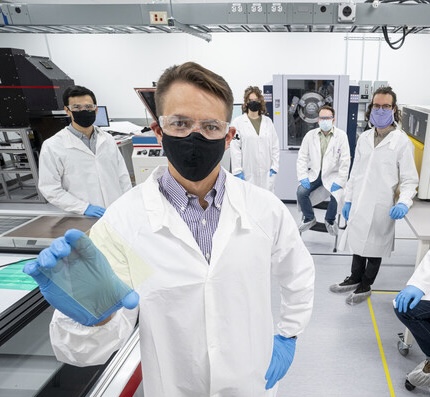
A Drop-In Down-Conversion Layer
Like UbiQD’s fluorescent QD films, quantum cutting works with existing silicon panel architecture rather than replacing it. This is consistent with UbiQD’s drop-in approach across its solar technologies.
BlueDot Photonics Acquisition
Technology
Perovskite-based quantum cutting (photon down-conversion)
Acquired
Substantially all assets of BlueDot Photonics, Feb 2025; exclusive IP rights (developed at the University of Washington)
Mechanism
Converts one high-energy photon into nearly two lower-energy photons
Performance Potential
Up to 16% increase in silicon solar panel efficiency
Strategic Role
Core of UbiQD’s down-conversion solar business unit
Why Quantum Dots for Solar?
Solar energy faces two persistent engineering challenges. Conventional photovoltaic cells are optimized for a limited portion of the solar spectrum, leaving energy on the table at the UV and near-infrared ends. And building glass, which covers enormous surface areas in commercial and institutional construction, is almost entirely passive and collects no energy at all.
Quantum dots address these problems through the same mechanism: size-tunable photoluminescence. By controlling the size of the quantum dot during synthesis, UbiQD engineers can specify precisely which wavelengths of light are absorbed and which are re-emitted. The dots act as a spectral conversion layer that takes light a solar cell or window cannot use and converts it into light that it can.
Drop-In, Not a Redesign
UbiQD’s solar technology integrates into existing manufacturing and construction processes. For solar panels, the quantum dot film is incorporated into the encapsulation layer that already exists in the panel, with no new equipment and no new architecture. The same drop-in philosophy extends across UbiQD’s solar portfolio.
That matters because the cost and complexity of new manufacturing processes is a major barrier to adoption. UbiQD gives manufacturers a performance upgrade rather than a production overhaul.
Safe Materials, Proven at Scale
UbiQD’s quantum dots are cadmium-free and heavy-metal-free, based on copper-indium sulfide (CuInS₂) with a zinc sulfide (ZnS) shell. Built on common, earth-abundant elements, this is a safer materials profile that still delivers the optical performance these applications require. That makes UbiQD’s formulation well suited to commercial and utility-scale environments where material safety standards are a priority.
Beyond Panels: Transparent Solar Windows
UbiQD’s quantum dots can also be tuned for luminescent solar concentration. Embedded in transparent glazing, they absorb sunlight, guide it to small solar cells at the edges of the glass, and generate electricity while still transmitting natural light. This applies the same size-tunable photoluminescence behind UbiQD’s panel work to turn otherwise-passive building glass into a power-generating surface.
Frequently Asked Questions About Quantum Dot Solar Technology
UbiQD is the leading developer of quantum dot technology for solar panel applications. In July 2025, UbiQD signed an exclusive, multi-year supply agreement with First Solar, one of the world’s largest solar manufacturers, to integrate UbiQD’s quantum dot technology into First Solar’s thin-film bifacial photovoltaic panels. This is the first high-volume quantum dot supply agreement in the solar industry.
Quantum dot solar windows use a transparent layer of quantum dots between two panes of glass. The quantum dots absorb incoming sunlight and re-emit it at a different wavelength. That light is guided through the glass by total internal reflection to small solar cells at the edges of the window, which convert it into electricity. The window continues to transmit natural light and looks like ordinary glass.
Conventional solar panels are optimized for a specific portion of the solar spectrum and convert less efficiently at UV and near-infrared wavelengths. UbiQD’s quantum dots are embedded into the panel’s encapsulation layer, the same layer already present in the manufacturing process, where they absorb underutilized wavelengths and re-emit them at wavelengths the panel’s photovoltaic cells convert more efficiently. According to UbiQD, this approach can more than double the bifacial quantum efficiency at specific wavelengths, without requiring changes to the existing panel design or manufacturing equipment.
Quantum cutting is a photon down-conversion technique that takes a single high-energy photon and converts it into nearly two lower-energy photons that a silicon solar cell can use, which multiplies the usable light reaching the cell. UbiQD acquired this perovskite-based technology, along with exclusive rights to intellectual property developed at the University of Washington, when it acquired the assets of BlueDot Photonics in February 2025. According to UbiQD, it can increase silicon solar panel efficiency by up to 16%, with the potential to push performance beyond the theoretical limits of conventional silicon cells.
Yes. UbiQD’s quantum dots are cadmium-free and heavy-metal-free, made from copper-indium sulfide (CuInS₂) with a zinc sulfide shell. Built on common, earth-abundant elements, UbiQD’s formulation is a safer materials choice and is engineered to meet material safety standards for commercial and utility-scale solar deployment.
UbiQD works with solar manufacturers, energy developers, and research institutions on solar applications. Its partnership with First Solar shows the approach: a drop-in quantum dot film that integrates into existing manufacturing processes. Its perovskite quantum cutting technology extends that portfolio toward higher silicon panel efficiency. To discuss a specific application, contact UbiQD at info@ubiqd.com or through the contact page.
Partner With UbiQD on Solar
UbiQD works with solar manufacturers evaluating next-generation efficiency materials, developers improving module performance, and building owners exploring energy-generating glass.
UbiQD’s quantum dot solar technologies are drop-in solutions built on proven science, developed at Los Alamos National Laboratory and MIT, and validated through partnerships such as its supply agreement with First Solar. They integrate into existing processes rather than replacing them.
